• Cart
    • Quote
    • Inquiry
USA
    • Cart
    • Quote
    • Inquiry
USA
Novogene
  • Novogene
  • Genomics
    • Human Whole Genome Sequencing
    • Whole Exome Sequencing
    • Plant and Animal Whole Genome Sequencing
    • Microbial Whole Genome Sequencing

    Metagenomics

    • Shotgun Metagenomics Sequencing
    • Amplicon Sequencing

    Transcriptomics

    • mRNA Sequencing
    • Swift & Express mRNA Sequencing New!
    • Full-Length Transcriptome Sequencing
    • Prokaryotic RNA Sequencing
    • Metatranscriptome Sequencing
    • Total RNA Sequencing
    • Small RNA Sequencing (sRNA‑seq)
    • Whole Transcriptome Sequencing

    Single Cell & Spatial Omics

    • 10x Single Cell Gene Expression
    • Illumina PIP-seq Single Cell 3’ RNA Sequencing New!
    • Spatial Transcriptomics Sequencing New!

    Epigenomics

    • Whole Genome Bisulfite Sequencing (WGBS)
    • Enzymatic Methylation Sequencing
    • Directed Methylation Sequencing (DM-Seq) New!
    • RNA Immunoprecipitation Sequencing (RIP-seq)
    • Chromatin Immunoprecipitation Sequencing (ChIP-seq)
    • Cleavage Under Targets & Tagmentation (CUT&Tag) New!
    • Assay for Transposase-Accessible Chromatin with Sequencing (ATAC-seq)
    • Reduced Representation Bisulfite Sequencing (RRBS)

    Proteomics

    • Quantitative Proteomics New!
    • PTM Proteomics New!
    • Olink Proteomics New!

    Metabolomics

    • Untargeted Metabolomics

    Premade Library

    • Sequencing Only on Illumina Sequencer
    • Sequencing Only on Ultima Sequencer
  • PromotionsPromotions
    • Platforms
    • Service & Support
    • Automated Delivery Platform (Falcon)
    • Bioinformatics Analysis Tool (NovoMagic)
    • Customer Service System (CSS)
    • Case Study
    • Blog
    • Webinar
    • Brochure
    • Cancer Research
    • Immuno-oncology
    • Agrigenomics
    • Environment
    • Food Science
    • Human Microbiome
    • Plant and Animal Microbiome
    • Drug Discovery and Development
    • Rare and Complex Diseases
    • About Us
    • Our Locations
    • News & Events
    • Careers
  • Contact UsContact Us
    • mRNA Sequencing
    • Illumina Lane Sequencing
  1. Home
  2. Resources
  3. Blog
  4. What Might Your Neuroscience Study Be Missing? A Single-Cell Perspective

What Might Your Neuroscience Study Be Missing? A Single-Cell Perspective

Discover which cells are changing and explore the regulatory programs behind those changes.

You have identified a neuronal population associated with disease. Its gene expression changes, but a crucial question remains: which regulatory programs might be involved, and which candidates deserve functional testing?

That gap shapes the next experiment. Single-cell RNA sequencing (scRNA-seq), using 10x 3′ Gene Expression, helps researchers identify relevant cell populations and expression programs. Single-cell multiomics, using 10x Multiome ATAC + Gene Expression, adds chromatin accessibility from the same nucleus, helping connect those programs with candidate regulatory mechanisms.

Single-cell RNA sequencing reveals which cells are changing

A tissue-level expression difference can reflect altered cell composition, changes within a population, or both. Resolving those possibilities is an important starting point in studies of neural development, aging, and disease.

10x 3′ scRNA-seq profiles gene expression in individual cells or nuclei, supporting cell annotation, comparisons of cell proportions, and identification of condition-associated expression programs. Nuclei-based workflows can make suitable frozen neural tissue accessible to these studies, subject to sample quality and preparation.[3]

A brain-wide aging study in Nature illustrates the value of this approach: profiling across brain regions revealed cell-type-specific aging signatures and a potential hypothalamic hotspot.[1] For a new project, the design question is whether the planned samples adequately represent the regions and populations where the biology may occur.
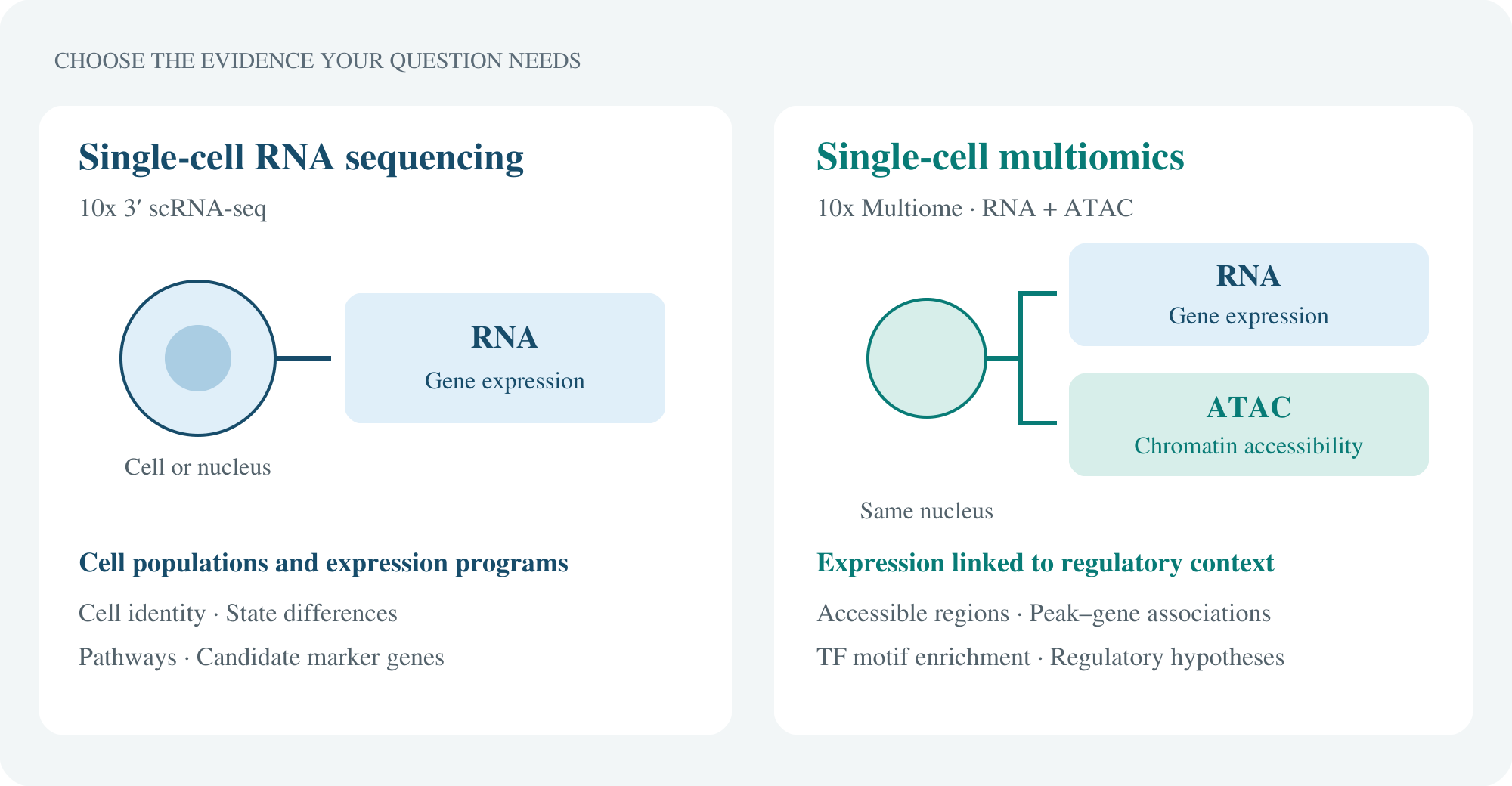
Figure 1. Match the assay to the research gap. Single-cell RNA sequencing measures expression at cell or nucleus resolution. Multiome pairs expression and accessibility in the same nucleus to support regulatory inference. Conceptual schematic, not experimental data.

Single-cell multiomics explores what may regulate those changes

Once a disease-associated cell state emerges, an expression signature alone may leave several explanations open. Different upstream regulatory programs can produce overlapping transcriptional responses.

By combining single-nucleus RNA sequencing (snRNA-seq) with an assay for chromatin accessibility (ATAC-seq), 10x Multiome measures gene expression and open chromatin in the same nucleus.[4] This pairing places each nucleus’s expression profile alongside its own accessibility landscape, helping researchers investigate regulatory differences within closely related cell populations.

Integrated analysis can identify regions with altered accessibility, associate candidate regulatory elements with gene expression, and assess enrichment of transcription factor binding motifs. Together, these results help prioritize transcription factors and regulatory programs for further investigation. Motif enrichment and peak–gene associations support hypotheses; functional experiments establish whether a candidate regulates the phenotype.

For neuroscience, this can address questions such as why related neuronal subtypes differ in vulnerability, which regulatory programs accompany a developmental transition, or how a treatment-associated cell state relates to chromatin changes. In an ALS study in Cell, paired RNA and ATAC profiling helped identify candidate regulators of a disease-associated motor neuron state, followed by experimental testing.[2]

If explaining a cell-state change is central to your hypothesis, Multiome can be planned from the outset. It can also serve as a focused follow-up to expression profiling, provided suitable material is reserved or collected for the additional assay.

Design the comparison before choosing the assay

A broad discovery project may use 10x 3′ scRNA-seq across its core groups, then focus Multiome on the comparisons most relevant to a regulatory question. A project centered on regulation may use Multiome directly. In either approach, biological replication and balanced processing batches remain essential for interpreting differences.
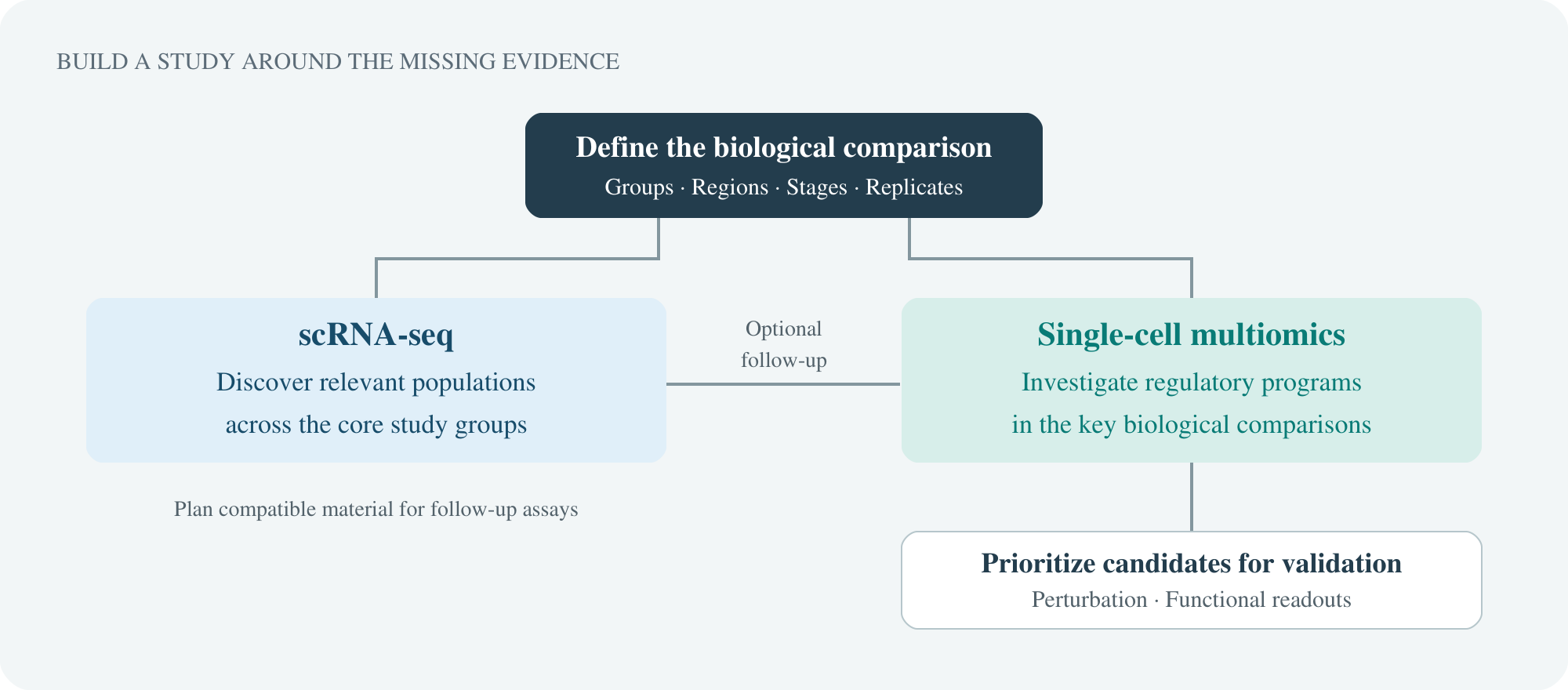
Figure 2. Two study designs for different objectives. Broad expression profiling can guide a focused Multiome follow-up, while a defined regulatory question can justify Multiome at the start. Follow-up requires compatible specimens and appropriate replication; sequencing an existing 3′ library again does not add ATAC information.

How Novogene supports the study

Novogene helps researchers connect the scientific question with sample requirements and an analysis plan. Support includes assessment of tissue format and cell or nucleus preparation strategies, followed by library preparation, sequencing, and bioinformatics for single-cell RNA sequencing and Multiome projects.

For scRNA-seq studies, analysis can characterize cell populations, compare expression within defined cell types, and investigate affected pathways. For Multiome, integrated RNA and ATAC analysis can extend those findings through differential accessibility, peak–gene association, and candidate regulatory network analysis, with the scope agreed during project planning.

Where tissue location becomes the next research gap, complementary spatial transcriptomics can help investigate the anatomical context of an identified signature.

Your next study may need broader cellular coverage, a better-timed comparison, or paired regulatory information. What evidence would help you move from an associated cell state to a testable biological hypothesis?

Explore single-cell RNA sequencing and multiomics study options with Novogene’s single-cell specialists.

References

[1] Jin K, et al. Brain-wide cell-type-specific transcriptomic signatures of healthy ageing in mice. Nature (2025). https://doi.org/10.1038/s41586-024-08350-8.

[2] Gautier O, et al. An emergent disease-associated motor neuron state precedes cell death in ALS. Cell (2026). https://doi.org/10.1016/j.cell.2026.05.047.

[3] 10x Genomics. https://www.10xgenomics.com/research-areas/neuroscience.

[4] 10x Genomics. https://www.10xgenomics.com/blog/answering-your-questions-about-chromium-single-cell-multiome-atac-gene-expression.

ServicesServices menu

CompanyCompany menu

Contact UsContact Us menu

Service SupportService Support menu

Services
mRNA SequencingSwift & Express mRNA SequencingTotal RNA SequencingHuman Whole Genome SequencingWhole Exome Sequencing10x Single Cell Gene ExpressionIllumina PIP-seq Single Cell 3’ RNA SequencingSpatial Transcriptomics SequencingWhole Genome Bisulfite Sequencing (WGBS)Quantitative ProteomicsUntargeted MetabolomicsShotgun Metagenomics SequencingMetatranscriptome SequencingSequencing Only on Illumina SequencerSequencing Only on Ultima SequencerFull-Length Transcriptome SequencingChromatin Immunoprecipitation Sequencing (ChIP-seq)
Company
About UsOur LocationsNews & EventsCareers
Contact Us
Contact Us
Service Support
Automated Delivery Platform (Falcon)Bioinformatics Analysis Tool (NovoMagic)Customer Service System (CSS)
LinkedInLinkedIn hoverYouTubeYouTube hoverXX hoverMetaMeta hoverInstagramInstagram hover
Copyright © 2026 Novogene Corporation Inc. All rights reserved. For Research Use Only.
    • Cart
    • Quote
    • Inquiry
USA
    • Cart
    • Quote
    • Inquiry
USA
Novogene
  • Novogene
  • Genomics
    • Human Whole Genome Sequencing
    • Whole Exome Sequencing
    • Plant and Animal Whole Genome Sequencing
    • Microbial Whole Genome Sequencing

    Metagenomics

    • Shotgun Metagenomics Sequencing
    • Amplicon Sequencing

    Transcriptomics

    • mRNA Sequencing
    • Swift & Express mRNA Sequencing New!
    • Full-Length Transcriptome Sequencing
    • Prokaryotic RNA Sequencing
    • Metatranscriptome Sequencing
    • Total RNA Sequencing
    • Small RNA Sequencing (sRNA‑seq)
    • Whole Transcriptome Sequencing

    Single Cell & Spatial Omics

    • 10x Single Cell Gene Expression
    • Illumina PIP-seq Single Cell 3’ RNA Sequencing New!
    • Spatial Transcriptomics Sequencing New!

    Epigenomics

    • Whole Genome Bisulfite Sequencing (WGBS)
    • Enzymatic Methylation Sequencing
    • Directed Methylation Sequencing (DM-Seq) New!
    • RNA Immunoprecipitation Sequencing (RIP-seq)
    • Chromatin Immunoprecipitation Sequencing (ChIP-seq)
    • Cleavage Under Targets & Tagmentation (CUT&Tag) New!
    • Assay for Transposase-Accessible Chromatin with Sequencing (ATAC-seq)
    • Reduced Representation Bisulfite Sequencing (RRBS)

    Proteomics

    • Quantitative Proteomics New!
    • PTM Proteomics New!
    • Olink Proteomics New!

    Metabolomics

    • Untargeted Metabolomics

    Premade Library

    • Sequencing Only on Illumina Sequencer
    • Sequencing Only on Ultima Sequencer
  • PromotionsPromotions
    • Platforms
    • Service & Support
    • Automated Delivery Platform (Falcon)
    • Bioinformatics Analysis Tool (NovoMagic)
    • Customer Service System (CSS)
    • Case Study
    • Blog
    • Webinar
    • Brochure
    • Cancer Research
    • Immuno-oncology
    • Agrigenomics
    • Environment
    • Food Science
    • Human Microbiome
    • Plant and Animal Microbiome
    • Drug Discovery and Development
    • Rare and Complex Diseases
    • About Us
    • Our Locations
    • News & Events
    • Careers
  • Contact UsContact Us
    • mRNA Sequencing
    • Illumina Lane Sequencing
  1. Home
  2. Resources
  3. Blog
  4. What Might Your Neuroscience Study Be Missing? A Single-Cell Perspective

What Might Your Neuroscience Study Be Missing? A Single-Cell Perspective

Discover which cells are changing and explore the regulatory programs behind those changes.

You have identified a neuronal population associated with disease. Its gene expression changes, but a crucial question remains: which regulatory programs might be involved, and which candidates deserve functional testing?

That gap shapes the next experiment. Single-cell RNA sequencing (scRNA-seq), using 10x 3′ Gene Expression, helps researchers identify relevant cell populations and expression programs. Single-cell multiomics, using 10x Multiome ATAC + Gene Expression, adds chromatin accessibility from the same nucleus, helping connect those programs with candidate regulatory mechanisms.

Single-cell RNA sequencing reveals which cells are changing

A tissue-level expression difference can reflect altered cell composition, changes within a population, or both. Resolving those possibilities is an important starting point in studies of neural development, aging, and disease.

10x 3′ scRNA-seq profiles gene expression in individual cells or nuclei, supporting cell annotation, comparisons of cell proportions, and identification of condition-associated expression programs. Nuclei-based workflows can make suitable frozen neural tissue accessible to these studies, subject to sample quality and preparation.[3]

A brain-wide aging study in Nature illustrates the value of this approach: profiling across brain regions revealed cell-type-specific aging signatures and a potential hypothalamic hotspot.[1] For a new project, the design question is whether the planned samples adequately represent the regions and populations where the biology may occur.

Figure 1. Match the assay to the research gap. Single-cell RNA sequencing measures expression at cell or nucleus resolution. Multiome pairs expression and accessibility in the same nucleus to support regulatory inference. Conceptual schematic, not experimental data.

Single-cell multiomics explores what may regulate those changes

Once a disease-associated cell state emerges, an expression signature alone may leave several explanations open. Different upstream regulatory programs can produce overlapping transcriptional responses.

By combining single-nucleus RNA sequencing (snRNA-seq) with an assay for chromatin accessibility (ATAC-seq), 10x Multiome measures gene expression and open chromatin in the same nucleus.[4] This pairing places each nucleus’s expression profile alongside its own accessibility landscape, helping researchers investigate regulatory differences within closely related cell populations.

Integrated analysis can identify regions with altered accessibility, associate candidate regulatory elements with gene expression, and assess enrichment of transcription factor binding motifs. Together, these results help prioritize transcription factors and regulatory programs for further investigation. Motif enrichment and peak–gene associations support hypotheses; functional experiments establish whether a candidate regulates the phenotype.

For neuroscience, this can address questions such as why related neuronal subtypes differ in vulnerability, which regulatory programs accompany a developmental transition, or how a treatment-associated cell state relates to chromatin changes. In an ALS study in Cell, paired RNA and ATAC profiling helped identify candidate regulators of a disease-associated motor neuron state, followed by experimental testing.[2]

If explaining a cell-state change is central to your hypothesis, Multiome can be planned from the outset. It can also serve as a focused follow-up to expression profiling, provided suitable material is reserved or collected for the additional assay.

Design the comparison before choosing the assay

A broad discovery project may use 10x 3′ scRNA-seq across its core groups, then focus Multiome on the comparisons most relevant to a regulatory question. A project centered on regulation may use Multiome directly. In either approach, biological replication and balanced processing batches remain essential for interpreting differences.

Figure 2. Two study designs for different objectives. Broad expression profiling can guide a focused Multiome follow-up, while a defined regulatory question can justify Multiome at the start. Follow-up requires compatible specimens and appropriate replication; sequencing an existing 3′ library again does not add ATAC information.

How Novogene supports the study

Novogene helps researchers connect the scientific question with sample requirements and an analysis plan. Support includes assessment of tissue format and cell or nucleus preparation strategies, followed by library preparation, sequencing, and bioinformatics for single-cell RNA sequencing and Multiome projects.

For scRNA-seq studies, analysis can characterize cell populations, compare expression within defined cell types, and investigate affected pathways. For Multiome, integrated RNA and ATAC analysis can extend those findings through differential accessibility, peak–gene association, and candidate regulatory network analysis, with the scope agreed during project planning.

Where tissue location becomes the next research gap, complementary spatial transcriptomics can help investigate the anatomical context of an identified signature.

Your next study may need broader cellular coverage, a better-timed comparison, or paired regulatory information. What evidence would help you move from an associated cell state to a testable biological hypothesis?

Explore single-cell RNA sequencing and multiomics study options with Novogene’s single-cell specialists.

References

[1] Jin K, et al. Brain-wide cell-type-specific transcriptomic signatures of healthy ageing in mice. Nature (2025). https://doi.org/10.1038/s41586-024-08350-8.

[2] Gautier O, et al. An emergent disease-associated motor neuron state precedes cell death in ALS. Cell (2026). https://doi.org/10.1016/j.cell.2026.05.047.

[3] 10x Genomics. https://www.10xgenomics.com/research-areas/neuroscience.

[4] 10x Genomics. https://www.10xgenomics.com/blog/answering-your-questions-about-chromium-single-cell-multiome-atac-gene-expression.

ServicesServices menu

CompanyCompany menu

Contact UsContact Us menu

Service SupportService Support menu

Services
mRNA SequencingSwift & Express mRNA SequencingTotal RNA SequencingHuman Whole Genome SequencingWhole Exome Sequencing10x Single Cell Gene ExpressionIllumina PIP-seq Single Cell 3’ RNA SequencingSpatial Transcriptomics SequencingWhole Genome Bisulfite Sequencing (WGBS)Quantitative ProteomicsUntargeted MetabolomicsShotgun Metagenomics SequencingMetatranscriptome SequencingSequencing Only on Illumina SequencerSequencing Only on Ultima SequencerFull-Length Transcriptome SequencingChromatin Immunoprecipitation Sequencing (ChIP-seq)
Company
About UsOur LocationsNews & EventsCareers
Contact Us
Contact Us
Service Support
Automated Delivery Platform (Falcon)Bioinformatics Analysis Tool (NovoMagic)Customer Service System (CSS)
LinkedInLinkedIn hoverYouTubeYouTube hoverXX hoverMetaMeta hoverInstagramInstagram hover
Copyright © 2026 Novogene Corporation Inc. All rights reserved. For Research Use Only.
Your Privacy ChoicesPrivacy PolicyCookie PolicyCareers