










Detailed applications can be found in library preparation compatibility guide and supported application documents.

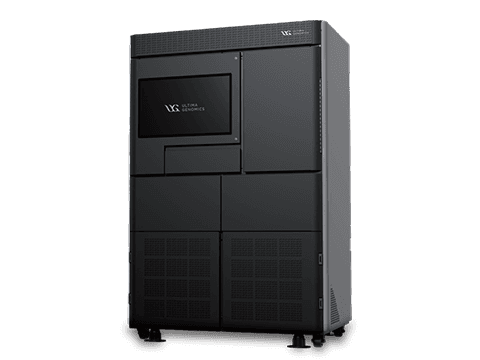
Through strategic collaboration with Ultima Genomics, Novogene is proud to be among the first Certified Service Providers (CSPs) for the UG 100 platform. With the UG 100 now fully integrated into our sequencing fleet, Novogene delivers a high-performance, scalable, and cost-efficient pre-made library sequencing solution, optimized for high-throughput research applications.

Up to 10 billion reads per wafer for ultra-high data output

Lower cost per million reads compared to other short-read platforms

Fast turnaround time with streamlined end-to-end workflow support

More efficient data delivery with CRAM format options

Compatible with both Ultima and Illumina libraries, with a seamless conversion service available

Local processing and sequencing in the U.S. for faster logistics and compliance
Detailed applications can be found in library preparation compatibility guide and supported application documents.
With Ultima’s UG100 Solaris platform, Novogene now provides pre-made library wafer sequencing on Ultima with end-to-end support—from sample submission to analysis guidance.

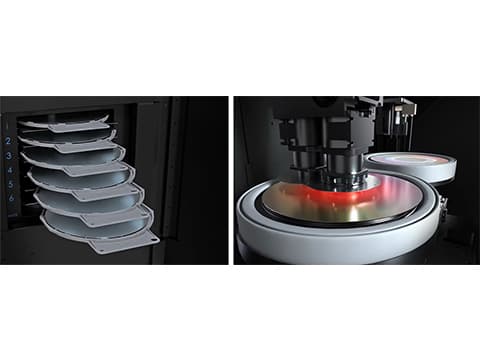
The UG 100 dramatically reduces sequencing costs by introducing a novel sequencing substrate built on 200-mm silicon wafers, a core material in the electronics industry. Instead of traditional microfluidics, the system uses contactless spin-coating, a manufacturing technique adapted from semiconductor fabrication.
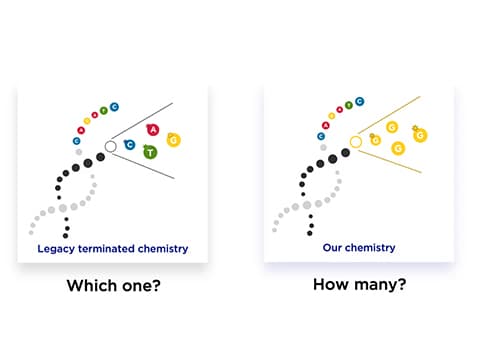
Its sequencing chemistry is largely natural, with only a small fraction of nucleotides labeled with fluorescent tags—significantly reducing reagent complexity and cost.
During each cycle, one nucleotide type (A, C, T, or G) is added across the entire wafer. The surface is then scanned to determine base incorporation. This shifts base calling from identifying which base was added to determining how many were incorporated. The fluorescent labels are subsequently removed using the same spin-coating process.
The system’s high-speed circular motion enables rapid, high-resolution imaging across the full wafer surface.
All of these innovations deliver not only cost and throughput advantages, but also exceptional data quality. With Ultima Genomics’ novel ppmSeq™ technology, single-nucleotide variants (SNVs) can be detected with one-part-per-million accuracy, setting a new standard for sequencing precision.

Our platform offers tailored solutions for
your unique experimental needs, ensuring a seamless experience from project design to data delivery.
Through strategic collaboration with Ultima Genomics, Novogene is proud to be among the first Certified Service Providers (CSPs) for the UG 100 platform. With the UG 100 now fully integrated into our sequencing fleet, Novogene delivers a high-performance, scalable, and cost-efficient pre-made library sequencing solution, optimized for high-throughput research applications.
Up to 10 billion reads per wafer for ultra-high data output
Lower cost per million reads compared to other short-read platforms
Fast turnaround time with streamlined end-to-end workflow support
More efficient data delivery with CRAM format options
Compatible with both Ultima and Illumina libraries, with a seamless conversion service available
Local processing and sequencing in the U.S. for faster logistics and compliance
Detailed applications can be found in library preparation compatibility guide and supported application documents.
With Ultima’s UG100 Solaris platform, Novogene now provides pre-made library wafer sequencing on Ultima with end-to-end support—from sample submission to analysis guidance.
The UG 100 dramatically reduces sequencing costs by introducing a novel sequencing substrate built on 200-mm silicon wafers, a core material in the electronics industry. Instead of traditional microfluidics, the system uses contactless spin-coating, a manufacturing technique adapted from semiconductor fabrication.
Its sequencing chemistry is largely natural, with only a small fraction of nucleotides labeled with fluorescent tags—significantly reducing reagent complexity and cost.
During each cycle, one nucleotide type (A, C, T, or G) is added across the entire wafer. The surface is then scanned to determine base incorporation. This shifts base calling from identifying which base was added to determining how many were incorporated. The fluorescent labels are subsequently removed using the same spin-coating process.
The system’s high-speed circular motion enables rapid, high-resolution imaging across the full wafer surface.
All of these innovations deliver not only cost and throughput advantages, but also exceptional data quality. With Ultima Genomics’ novel ppmSeq™ technology, single-nucleotide variants (SNVs) can be detected with one-part-per-million accuracy, setting a new standard for sequencing precision.
Our platform offers tailored solutions for
your unique experimental needs, ensuring a seamless experience from project design to data delivery.