
Single-Cell RNA Sequencing: Platform Benchmarking Across Real-World Samples
Comparative analysis of two leading commercial workflows for transcriptomic profiling

Background
Single-cell RNA sequencing (scRNA-seq) remains at the forefront of efforts to characterize cellular heterogeneity across tissues and disease states. As the single-cell landscape continues to evolve, researchers now have access to multiple commercial platforms capable of generating high-quality transcriptomic data — each with distinct performance profiles across sample types.
At Novogene, we support both the 10x Genomics Chromium and Illumina PIP-seq platforms and are frequently asked by researchers how they compare in practice. To address this directly, our R&D team conducted a systematic internal benchmarking study evaluating these two widely adopted workflows side by side.
In our previous benchmarking study using human PBMC and mouse spleen samples, we observed strong concordance between platforms in cell recovery, transcriptomic complexity, and cell-type composition. These findings established a strong foundation for cross-platform reproducibility across relatively well-characterized sample types. Additional details are available in the technical poster shown below (Figure 1).
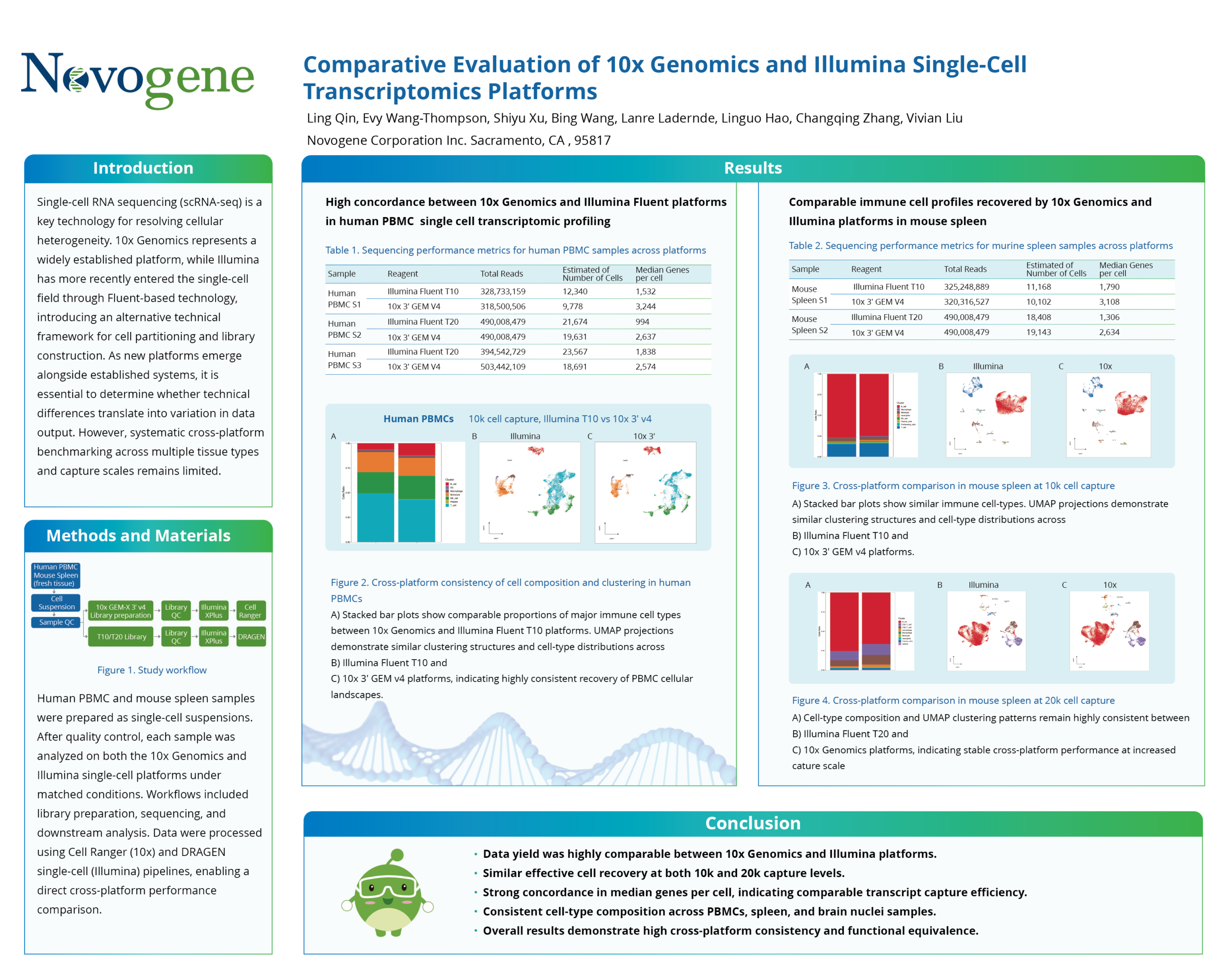
Figure 1 Technical poster from Novogene’s previous cross-platform benchmarking study. Results from human PBMC and mouse spleen samples demonstrated highly consistent cell recovery, transcriptomic profiling, and cell-type composition across 10x Genomics and Illumina workflows, motivating further evaluation in more complex tissue and nuclei-based samples.
Building upon these initial observations, we expanded the evaluation to more technically challenging sample types—human skeletal muscle and mouse tumor nuclei preparations—to assess platform performance under conditions commonly encountered in tissue-based and translational research.
Study overview
Two tissue types were used in this benchmarking study: human skeletal muscle and mouse tumor. Human muscle samples were processed to generate high-quality single-cell suspensions, while mouse tumor tissue underwent nuclei isolation to produce clean single-nuclei preparations suitable for downstream transcriptomic profiling. All samples then proceeded through a standardized quality-control assessment — evaluating cell or nuclei viability, concentration, and overall integrity — prior to library construction.
Each qualified sample was subjected to a head-to-head comparison across three parallel workflows: (1) the 10x GEM-X 3′ v4 library preparation protocol targeting 10,000 cells, processed with Cell Ranger; (2) the Illumina PIPseq 3′ T10 protocol also targeting 10,000 cells, analyzed with DRAGEN; and (3) a second Illumina PIPseq 3′ T10 run targeting 20,000 cells, also processed with DRAGEN. Across all three arms, libraries underwent quality control before sequencing on the Illumina NovaSeq X Plus.
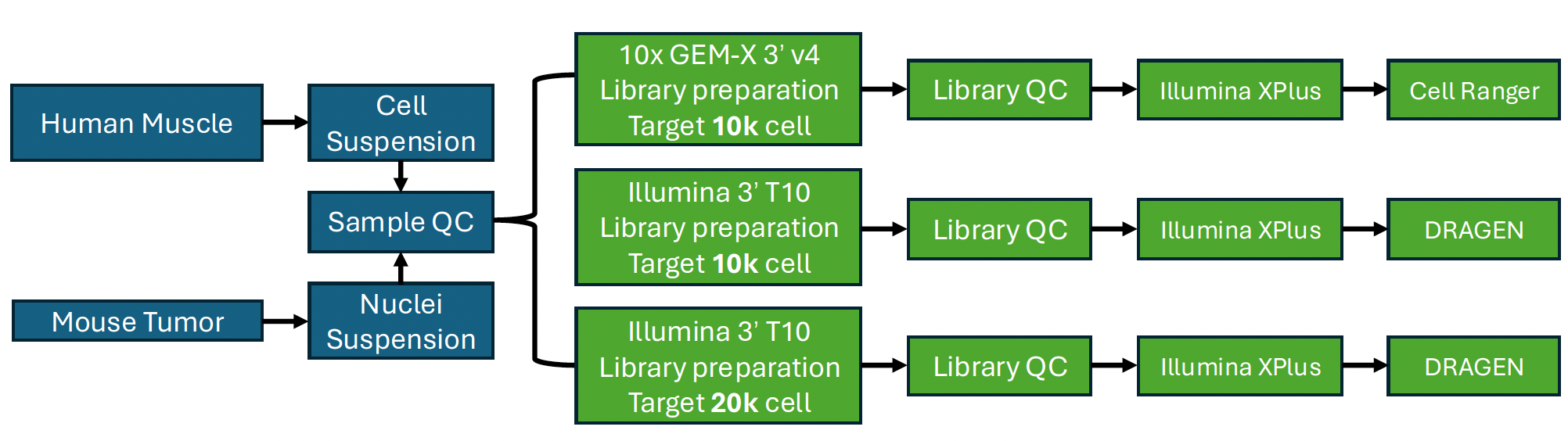
Figure 2 Head-to-head benchmarking workflow for 10x Genomics and Illumina PIPseq scRNA-seq platforms.
Results
Cross-Platform Evaluation in Mouse Tumor Nuclei SamplesTo assess platform performance in challenging nuclei-based preparations, mouse tumor samples were processed as single-nuclei suspensions and analyzed using both workflows under a 10,000-cell target configuration.
Overall, both platforms recovered a comparable number of nuclei and generated high-quality sequencing datasets suitable for downstream transcriptomic analysis. Sequencing output, cell recovery, and reads-in-cells metrics showed strong agreement between workflows, supporting reliable profiling of tumor-derived nuclei preparations (Table 1).
Table 1 Performance comparison of 10x Genomics and Illumina PIPseq workflows in mouse tumor nuclei samples targeting 10,000 cells.
 Exploring Higher Cell Capture Conditions with Illumina PIP-seq
While the Illumina PIPseq T10 workflow is designed for a target recovery of approximately 10,000 cells, we were interested in evaluating its performance under higher cell-loading conditions. To explore this, an additional mouse tumor nuclei sample was processed using both 10,000-cell and 20,000-cell target configurations.
Under the higher loading condition, the workflow recovered substantially more nuclei while maintaining overall sequencing performance metrics. These results suggest that, under appropriate sample and experimental conditions, the workflow may support cell recoveries beyond its standard target range, providing additional flexibility for studies requiring increased cellular representation (Table 2).
Table 2 Comparison of Illumina PIPseq performance under 10,000-cell and 20,000-cell target loading conditions in mouse tumor nuclei samples.
 Performance in Human Skeletal Muscle Samples
To evaluate performance in complex tissue-derived single-cell suspensions, human skeletal muscle samples were analyzed using the 10x Genomics workflow targeting 10,000 cells and the Illumina PIPseq workflow targeting 20,000 cells.
Both workflows generated high-quality datasets with strong cell recovery and transcriptomic complexity. Notably, the Illumina PIPseq workflow recovered nearly 20,000 cells from the muscle sample, demonstrating its capability for higher-throughput applications while maintaining data quality suitable for downstream biological analyses (Table 3).
Table 3 Comparison of human skeletal muscle datasets generated using 10x Genomics and Illumina PIPseq workflows.
Discussion
As single-cell technologies continue to evolve, researchers increasingly have access to multiple high-quality workflow options. In this study, both evaluated platforms generated robust datasets across human skeletal muscle and mouse tumor samples, extending our previous observations in PBMC and spleen tissues. We also explored higher loading conditions with the Illumina PIP-seq T10 workflow, demonstrating the potential for increased cell recovery under suitable experimental conditions. Overall, our results suggest that workflow selection should be guided by study objectives, sample type, and desired throughput.
Conclusion
Building upon our previous benchmarking studies, this expanded evaluation demonstrated strong performance across multiple sample types, including human skeletal muscle and mouse tumor nuclei preparations. Both workflows generated high-quality datasets suitable for downstream transcriptomic analysis, while additional testing highlighted the flexibility of the Illumina PIP-seq T10 workflow under higher loading conditions. Together, these results provide researchers with additional data to support platform selection for diverse single-cell applications.
Why Choose Novogene for Single-cell RNA Sequencing (single-cell RNA-Seq or scRNA-Seq)?
Proven Expertise: With over 200,000 successfully sequenced samples, Novogene delivers great project results at industry-leading turnaround times. We excel at handling challenging sample types, including nerve and adipose cells.
Enhanced Sample Processing: We offer a diverse range of sample processing capabilities, including nuclei extraction and specialized pipelines for frozen tissues. This ensures high-quality gene expression data in Single-cell RNA Sequencing (single-cell RNA-Seq or scRNA-Seq) projects.
Certified Excellence: As a 10x Genomics Certified Service Provider, we leverage the advanced Chromium X platform combined with GEM-X technology for superior reproducibility and efficiency.
Cost-Effective Solutions: We have state-of-the-art high-throughput sequencing platforms, coupled with expert support, which ensure exceptional data quality and provide cost-effective solutions for single-cell projects.
